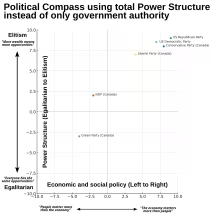
Here is a political compass that uses more meaningful concepts than government authority.
Power in our society doesn’t come from government alone, it comes from an intertwined system of corporations, media, finance, and institutions that shape every aspect of our lives. Terms like libertarian are vague, inconsistent, and often used to mask these deeper dynamics.
A chart grounded in real-world power structures, and showing where parties and ideologies actually operate is far less misleading than the sanitized models promoted in mainstream political discourse.
Because in those circles, conversations about power are deliberately flattened. The role of concentrated wealth, elite influence, and systemic exclusion is minimized, not because it isn’t real, but because naming it directly would challenge the legitimacy of those who benefit from keeping it invisible.
What does it mean?
On the Left–Right axis, the midpoint reflects a government policy landscape where human wellbeing and economic growth are treated as equally important. It represents a system where public services, fair markets, and social equity are not in conflict, and government policy aims to support both people and productivity simultaneously.
On the Egalitarian–Elitism axis, the midpoint marks a society partway toward the decentralization of power and wealth. Privilege still arises from hard work or innovation, but it rarely comes at the cost of others’ access, safety, or dignity. Some structural exclusion still exists, as it is an inevitable feature of a commerce-based society.
The parties and placement:
US Democratic Party Center-right (+7) Elitist (+8) Corporate donors, think-tank technocrats, elite media class, suppresses grassroots
US Republican Party Far-right (+9) Elitist (+9) Openly plutocratic, oligarchic, white nationalist elements
Liberal Party (Canada) Center-right (+4) Elitist (+7) Polished elite party; reinforces inequality behind diversity optics
Conservative Party (Canada) Right (+8) Elitist (+8) Strong alignment with capital and authority
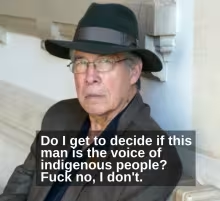
Colonization didn’t just steal land, it stole voice, narrative, and representation.
Today, even well-meaning institutions can replicate that theft when *they* choose who counts as Indigenous, based on commercial logic and not community accountability.
So when a person like King is elevated while many Indigenous writers struggle to get published, funded, or respected, that’s not just a quirk of the market, it’s systemic erasure.
I believe the root of most political and social problems lies in who controls money, land, and power and that control shapes the laws we live under, the media we consume, the wars we’re asked to support, and the public opinion we're told is common sense.
I see the state, corporations, and media working together to protect the interests of the powerful.
I push for radical truth‑telling and accountability, and I am critical of those who hide behind politeness, rules, or neutrality to avoid confronting injustice.
I care more about real fairness and freedom than about preserving a political system that was never built to represent me or most working‑class people.
I reject the idea that party loyalty or official narratives are valid or deserve respect when they function to exclude, exploit, or silence the majority.
I also reject the idea that Western dominance on the world stage is moral or benevolent. It’s upheld through war, sanctions, and economic coercion that protect elite interests at home and abroad. This dominance is maintained by manufacturing and spreading hate and fear, tools used primarily, though not exclusively, to shut down critical thinking and keep people divided.
I believe in confronting entrenched power, not reforming around it. Real justice begins with truth, solidarity, and a refusal to normalize exploitation. Speaking out to connect the dots and making meaningful connections with people in our own communities are the two most powerful acts of resistance we can do.
So am I left, as in I support Mark Carney, the US Democrats, and Israel?
Fuck no.
If you push past the cognitive dissonance, it becomes clear:
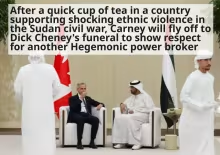
- Mark Carney is not progressive.
- US Democrats work for the wealthy and bomb the shit out of brown people.
and
- Zionism is not a healthy or essential part of Jewish identity, it's a political ideology.
What you've been told is "left" is well past the center and is clearly right. It's been drifting that way since Reagan.
The actual, everyday left doesn't have a voice in the political arena because that would be bad for the people who own the arena (not you).
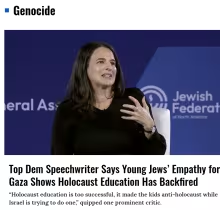
Sarah Hurwitz got up onstage and basically said the quiet part out loud. She starts talking about Israel, Gaza, Jewish identity, “Never again,” all the greatest hits. And then, right in the middle of trying to use that phrase to defend what Israel is doing, she hears herself.
She actually says “I sound obscene.”
Yeah. You do. Because the hypocrisy is right there in neon lights.
“Never again” is supposed to mean never again for anyone. Not “never again for my group while we look the other way when someone else gets crushed.”
And that moment? That’s significant. It’s not just a miscalculation. It’s the sound of the whole narrative creaking under its own weight. A believer in the official story suddenly sees the real-world carnage, tries to say the old words, and they don’t land.
You can practically hear the screws popping under the weight of all that cognitive dissonance.
But here’s the thing. Watching people wake up this slowly? It’s fucking infuriating.
People are dying while everyone takes their sweet time sorting out their moral confusion like it’s some extra-credit assignment.
This isn’t a seminar. It’s not journaling time. It’s a humanitarian nightmare happening right now.
Hurwitz’s little meltdown is part of a bigger process, sure. People need to see these contradictions explode out in the open. They need to watch someone who once wrote speeches for presidents suddenly realize the slogans don’t match the reality. Fine. Good. Let the whole world see it.
But we gotta speed this up.
Seriously.
Every polite pause, every “wow, I never questioned this before” moment? Someone else is paying the price for that delay.
And they’re not paying with awkwardness. They’re paying with their lives.
The violence doesn’t stop and wait for everyone to catch up morally. The bombs don’t take a timeout because a former White House speechwriter needs a few minutes to recalibrate her worldview.
So yes, let Hurwitz’s moment stand. Let it show people that the old narratives are cracking and even their defenders can’t keep a straight face anymore. But enough with the slow-motion awakening.
The truth is already out. The reality is already visible.
The suffering is already catastrophic.
We don’t need more time to think about it.
We need people to stop hiding behind dead slogans and start acting like reality matters right now.
Across Judaism, Christianity, and Islam, no large-scale, sustained campaign of extreme violence has ever been driven intrinsically by religious goals.
Religion cannot do that.
It does not command armies, raise budgets, build supply chains, or plan invasions. Violence cannot reach the scale of an organized campaign without logistics, hierarchy, resources, territory, soldiers, and political authority.
These are the instruments of rulers and states, not prophets or scripture. Religion can amplify a message, but it cannot produce the machinery of organized war.
Political elites exploit fear, grievance, and insecurity.
They take ordinary cultural or religious differences and reshape them into hardened lines of conflict. What begins as difference becomes division, and what begins as division becomes justification.
Religion becomes the language through which power speaks, not the source of what power seeks.
And the order of causation matters. The political motive comes first. Religious leaders may shape belief among ordinary people, but they do not control the flows of capital or the deployment of armies. Religious beliefs are not strong enough to make someone inflict extreme violence on a population.
But money and power are.
That is how wealth and dominance consolidate themselves. It is self-reinforcing.
Money and power outrank religion and values every time. The ruling class does not subordinate itself to clerics. It recruits clerics to discipline the masses.
Even in a shitshow where a religious figure occupies political power directly, the violence that follows serves the logic of state formation, not spiritual zeal. It's state-building. It is political consolidation dressed in sacred language.
Religion can motivate people, give violence a moral glow, and turn killing into a sacred obligation. But it never replaces the underlying political economy that organizes and directs the violence.
With this in mind, consider what is being concealed when someone insists that “they hate us for our religion, our freedom, our values.” That claim only works when history is erased. It only works when political motives stay hidden.
What disappears from view is occupation, sanctions, coups, extraction, and decades of domination. And when the public reacts with fear or anger toward distant populations, that reaction is not born from doctrine. It is shaped by narratives created by those who own the institutions that manufacture consent.
The root of these conflicts is political struggle, not theological quarrel. The actors who cause wars, and the ones who profit from them, rarely appear in the stories told to the public.
Instead, we are given tales of fanatics and extremists to hide interests that are entirely worldly.
That needs to change.
Whenever you encounter a call to violence claiming to be about religion or values, pause and ask: Who profits from the sale of the weapons. Who commands the bases and why those bases exist. Who controls the flow of trade, the authority over loans, the power to impose sanctions, the right to ship arms, and the media that frames the story.
If the conflict is described as ancient hatred but rests on occupation or geopolitical leverage, it is not religious violence.
It is political violence dressed in religious vocabulary.
It is not Islam, Christianity, or Judaism that created the devastation. It is the Sykes Picot map, the Balfour Declaration, the Truman Doctrine, and the imperial strategies that followed them that have taken millions of lives.
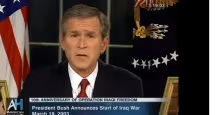
When a reporter asked George W Bush whether he had consulted his father before invading Iraq, he replied, “There is a higher father that I appeal to.” With one sentence, he shifted accountability upward, away from the architects of policy and toward a divine mandate. That response did not express spiritual conviction. It exposed the class structure that underpins political violence.
A president acting as the executive of the ruling class invoked religion to secure obedience from those beneath him. And many accepted it as truth.
And what did this cost ordinary people in the United States:
two to four trillion dollars, thousands of lives, tens of thousands wounded, entire communities living with long-term trauma, and no strategic benefit to the public.
No advancement in peace.
No advancement in the Christian values invoked to justify it.
And what did Iraq receive:
hundreds of thousands dead, likely more than six hundred thousand, mass displacement, shattered infrastructure, sectarian fragmentation, the rise of ISIS, and decades of instability.
Who won:
oil-adjacent corporations, private contractors, the defense industry, intelligence and security agencies, geopolitical strategists, and political elites seeking domestic consolidation. Those are the beneficiaries.
So maybe it is time for a new phrase. Something accurate. Something that points to the real threat.
Call them Radical Capital Extremists.
And I promise you: those individuals are not your defenders.
This is what happens when you put a banker in charge.
(Warning: As popular as Carney is, the truth is we are in deep trouble.)
Like so many others, I’ve spent years pushing for serious climate action because we are already living with the damage. I believed that if we raised our voices, demanded better, and insisted that governments act, we could drive real change.
But now I see that my enthusiasm, urgency, and moral clarity is being used not to protect the planet, but to make Mark Carney’s rich friends happy.
He says governments need to adopt "new values" to meet the climate crisis. But what he’s really done is turn our values into a blank cheque: public money funneled to investors, corporations, and asset managers with no strings attached, no hard targets, and no guarantees of actual emission reductions.
It’s climate policy as venture capital. "With a focus on results over objectives.”
That's disgusting.
And I won’t have it.
Climate action is being twisted into a pretext to give the rich more, while demanding sacrifice from the rest of us.
That’s not just wrong, it’s backwards.
Canada needs electeds who take climate policy seriously, not as a branding exercise, but as a mandate to deliver real, measurable results. We don’t need more deals, credits, or market-based promises. We need fewer emissions in the air. Now.
Carney’s initiatives will create austerity for workers: higher costs, tighter margins, and more economic precarity, while the wealthy glide above it all, shielded from consequence.
Yes, real climate policy should come with pain but it should hurt them:
-The ones who profited from pollution.
-The ones who hoarded the gains and offloaded the costs.
-The ones who lobbied to delay, deflect, and deregulate.
They should take the brunt of it.
The fucking planet is on fucking fire, and the plan is investors are to collect rebates.
Now is the time to pay attention.
The NDP are electing a new leader.
The Ontario government is drowning in scandal.
This is the moment to pay attention, stop rewarding political performance, and start demanding outcomes.
Don’t take any politician seriously unless they do what’s in your best interest:
Measurable climate results.
Fair costs.
Real accountability.
We need to see it and speak out. We need to flex. No more blank cheques or there will be payback.
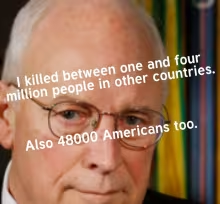
By any objective measure, Dick Cheney was a bad, bad human being.
His life’s work was the conversion of blood into money.
He oversaw invasions built on lies, profited through Halliburton and its affiliates, and left entire nations in ruins while calling it “defense.”
He did not serve his country, he served the system that owns it.
When news outlets strongest language about his is “divisive” or “controversial,” they are not reporting facts, they are performing damage control for the empire.
When voices only mention his devotion to his country, I feel queasy.
Sanitization is not an accident of style, it is the operational mode of a system whose function is to protect power from accountability.
This is the first red flag for any critical observer: when mass violence is reduced to “policy disagreements,” you are not reading journalism, you are reading public relations for the ruling class.
Such coverage tells you that the outlet cannot be trusted to describe reality.
The purpose of this language is twofold.
First, it depoliticizes crime by converting it into personality: “divisive,” “polarizing,” “complex.”
Second, it preserves the illusion of national innocence.
If Cheney is only “divisive,” then America itself remains virtuous, forever cleansing its sins with adjectives.
But here’s the structural irony: this very dishonesty is also the weak point of the propaganda system.
If enough people recognize the insult to their intelligence, if they simply tune out, the machine loses its audience, its clicks, its advertising revenue, and its ideological reach.
Propaganda requires attention to function.
Starve it of legitimacy and it starves of profit.
For them, truth is bad for business.
That is why those who tell it are marginalized, and those who conceal it are promoted.
But the moment audiences reclaim their critical faculties, the empire’s story begins to collapse under its own absurdity.
The antidote to propaganda is not cynicism, it is conscious withdrawal from lies.
And when you turn it off, you have already taken the first revolutionary act.
Then, find another source that is telling you the truth.
Because the struggle against empire begins with the struggle over perception.
Who controls information controls consent. And gets to write history in real time.
Seek out those who do not flinch from reality.
Seek out the ones who show you the blood behind the budget.
That’s where democracy begins, in the refusal to be fooled and in the courage to look at what power wants you to forget.
His life’s work was to funnel U.S. taxpayer money to the wealthy through endless military spending. “They hate us for our freedom” wasn’t a reflection, it was narrative control, crafted to vilify foreign people so Americans would feel scared enough to fund the violence abroad that created the very insecurity they feared.
He built a self-fulfilling, self-funding spiral of terror, a feedback loop of fear, war, and profit all to enrich those who already owned everything.
 Because I can.