
"Gramsci's Hegemony is the process by which ruling groups shape culture and “common sense” so thoroughly that people accept inequality and corruption as natural and inevitable. It is not maintained by force alone but by consent, by shaping desires, expectations, and beliefs."
---
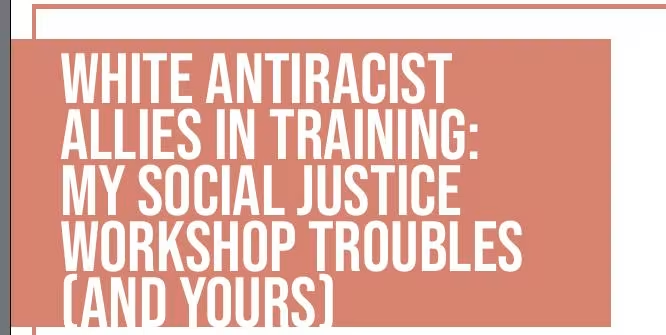
In “White Antiracist Allies in Training: My Social Justice Workshop Troubles (and Yours),” published in Blue Mountain Review in June 2021 (pp. 170–183), the author writes with the conviction that America’s racial divisions can be healed through mutual recognition, common ground, and a spiritual commitment to one another’s well-being. He invokes the dream that if people could simply see each other clearly and affirm each other’s humanity, then the shadows of the color line might dissipate.
It is a hopeful sentiment, resonant with the rhetoric of liberal optimism and evocations of a “beloved community” that have circulated since the civil rights era.
But embedded in this vision is a refusal, or perhaps an inability - I do not know which is scarier - to grapple with the structures that shape racial life in America.
The dream of “just getting along” collapses once one considers how deeply inequality is embedded in law, policy, and economic arrangements. Shared humanity cannot erase housing segregation, employment discrimination, school funding inequities, mass incarceration, or generational wealth gaps. Goodwill does not redistribute resources.
By framing racial problems as interpersonal misunderstandings or failures of empathy, the author narrows his lens to the psychological and the cultural, leaving untouched the systemic scaffolding that ensures inequality persists.
What makes this even more troubling is that the article does not merely overlook systemic injustice. It casts suspicion on the very antiracist movements that confront it.
Antiracist organizations are portrayed as strident, divisive, even counterproductive. The suggestion is that their critiques risk worsening the problem, as though calling out injustice is the real source of discord.
This is a familiar move: to vilify those who demand structural change because their insistence unsettles the comfort of common ground optimism, the dream of beloved community, and, incidentally, the ruling order where the wealthy hold more power than voters in every aspect of society.
Placed alongside Charlie Kirk and his brand, the similarity becomes stark. Kirk insisted that America was fundamentally fair, that anyone could succeed through personal responsibility, and that focusing on systemic racism was divisive. For him and his entourage, any antiracist statement, by definition, tore the nation apart.
His rhetoric was blunt, populist, and profitable. Outrage and denial of systemic injustice generated clicks, filled speaking halls, and drove donations. His denial was a business model.
The author of the Blue Mountain Review article, Adam Gussow, took a different route to a similar conclusion. Where Kirk monetized outrage, Gussow presents himself as the courageous contrarian, casting himself as a heterodox thinker and brave dissenter.
In practice, both undermine antiracist work by reframing it as the problem rather than the solution. Both argued, in different registers, that those who called attention to systemic injustice were the ones tearing society apart.
Yet how ridiculous is that, given the overwhelming evidence? Racial wealth gaps persist across generations. Schools remain segregated and unequally funded. Disparities in healthcare, policing, and incarceration are well documented. To argue that naming these truths is the problem, rather than the structures that produce them, is to invert reality.
It is like blaming the fire alarm for the fire.
The tragedy lies in motivation. For Kirk, the calculus was cynical. His posture was monetized. From a salary of about US $27,000 in 2016, his compensation at his nonprofit organization, Turning Point USA, rose to over US $407,000 by 2021. Over the same span his group’s revenues grew dramatically, and he acquired multiple high-end properties, including a multimillion-dollar estate in Arizona.
For Gussow, it is sadder. He seems to genuinely believe that common ground is enough, that antiracist movements are the obstacle rather than the engine of justice. One denied out of self-interest, the other out of misplaced faith. Both arrive at the same dead end, a refusal to reckon with the structures that must be changed.
Yet denial is only one tactic. Equally destructive are strategies that pretend to address systemic issues but are hollow by design. These partial or superficial efforts create the illusion of reform while ensuring failure.
Consider how diversity, equity, and inclusion (DEI) initiatives are sometimes implemented. The principle of DEI is sound, to broaden access, correct imbalances, and ensure marginalized groups are represented and empowered. But when implementation is reduced to transactional incentives, such as tax breaks for hiring a certain number of employees from marginalized groups, the reform is sabotaged from the start. It's another win systemic racism.
Companies comply for financial gain, not justice, and the deeper issues of pay gaps, promotion bias, and workplace culture remain untouched.
Predictably, resentment grows, results disappoint, and soon critics declare DEI itself a failure.
That failure is not proof of the principle’s weakness. It is the product of a system designed to neuter real change.
The red flag is someone who calls out DEI instead of shining a light on the sabotage. Nowhere in the story is there mention of the sabotage.
This pattern is not unique to Kirk or to Gussow. They are simply two examples in a wide field of actors who perpetuate inequality in plain sight. Some did it through common ground optimism that erased structures. Others did it through weaponized accusations of division whenever injustice was named. Still others did it through shallow reforms that were destined to collapse and discredit the cause.
Different as they seem, these strategies converge in their outcome: preserving the status quo while appearing to engage with racial justice.
Example: Media presence is inversely related to how directly someone confronts root causes.
The persistence of such hollow strategies is no accident. So who benefits from these failures?
They serve powerful interests across society:
Politicians and media figures: For figures like Kirk, denying systemic racism was a business. The narrative of division and victimhood culture sold books, filled speaking halls, and drove donations. The outrage itself was monetized.
Corporations and HR departments: Many businesses embraced DEI in its most superficial form, through diversity trainings, photo-op hires, or tax-incentive quotas, because it boosted reputation while avoiding costly restructuring. True equity would have meant raising wages, altering promotion pathways, or addressing bias in management culture, all of which threatened profits. Symbolic reform let them look progressive without ceding real power.
Real estate and banking: Segregated housing patterns and discriminatory lending remain immensely profitable. Programs that gesture toward affordable housing or community reinvestment often fall short by design, maintaining property values and profit margins for developers, landlords, and lenders.
Policing and prisons: Entire industries depend on maintaining racialized patterns of surveillance and incarceration. Reforms framed as community policing or sensitivity training rarely challenge the underlying incentives, such as budgets tied to arrests, private prison contracts, or union protections for misconduct. Token reforms protect these revenue streams while appearing responsive.
Higher education and nonprofits: Universities and NGOs can attract funding by advertising their commitment to diversity and inclusion, yet often stop short of transforming curricula, admissions, or governance structures. The result is a cycle where students and donors are reassured, while inequities in access and outcomes remain intact.
Cultural figures and institutions: Gussow benefits by presenting himself as the courageous truth-teller, the one willing to say the things others are too afraid to say. It is a familiar pose: cast yourself as embattled, as someone risking reputation by voicing an unpopular truth. In practice, it is a license to be an asshole while claiming victimhood.
He dismisses antiracist organizations as divisive, while dressing up his stance as noble contrarianism. Pushback becomes proof of his bravery, insulating him from critique. The irony is that his words do not challenge entrenched systems of racism. They challenge those who seek to dismantle them. His role grants him cultural capital, the glow of rebellion without the cost of real resistance.
The result is a cycle in which failed reforms are not only tolerated but desired. They protect the existing order by showing that something was tried and by allowing critics to argue that comprehensive reform is impossible. The system perpetuates itself in plain sight, through denial, through vilification of antiracism, and through actions designed to fail.
Why are such failures accepted, even celebrated, despite the obvious harm and despite running contrary to people’s own interests? Here Antonio Gramsci’s concept of hegemony is indispensable.
Hegemony is the process by which ruling groups shape culture and “common sense” so thoroughly that people accept inequality and corruption as natural and inevitable. It is not maintained by force alone but by consent, by shaping desires, expectations, and beliefs.
Every tactic outlined above, whether Kirk’s monetized outrage or Gussow’s contrarian optimism, functions within this hegemonic framework. And in every case, the key to unraveling it is the question cui bono, who benefits?
Narrative control: Politicians and media benefit when misconduct is reframed as virtue.
Normalization through repetition: Scandals lose power, benefiting those who repeat them until they seem ordinary.
Delegitimizing critique: Leaders benefit when critics are painted as divisive rather than truth-telling.
False choices: Parties and institutions benefit when people settle for “lesser evils.”
Displacement of blame: Systems benefit when poverty or injustice is blamed on individuals rather than policies.
Affective investment: Leaders benefit from loyalty built on hope, patriotism, or identity.
Incentivized ignorance: Employers and institutions benefit when silence is rewarded and dissent punished.
Hegemony itself: Ruling classes benefit when inequality is mistaken for inevitability.
Asking cui bono turns normalization inside out. It shows that acceptance is not passive blindness but the result of an active system of benefits and incentives.
What looks like resignation or naiveté is in fact the outcome of a carefully structured order that ensures the unacceptable feels normal.
I bet you can sense that things aren’t normal. For four decades, U.S. elections haven’t been decided on what’s best for the wellbeing of all citizens, but on money.
The “war on crime” and the “war on drugs” institutionalized racism.
Immigration policies sidelined the demographic and economic benefits of newcomers and instead left them more open to exploitation.
Obamacare was never universal health care, only a patch on a for-profit system.
And the Iraq war was never about safety or peace, just more war spending from taxpayers' pocketbooks to big corporations who supply arms.
Unity and common ground are not wrong in themselves. They are necessary. But without confronting the systems that perpetuate racial injustice, calls for togetherness and half-measures of reform are empty slogans.
Whether spoken with hope from the mountaintop, shouted with certainty from a political rally, or dressed up as corporate diversity programs, they offer comfort without change, a dream of healing that leaves the wound open while those in power continue to profit from keeping it that way.