
Awareness Is How It Ends - How Netanyahu’s need for enemies became a system of domination, and why exposing genocide is the only way to stop it
The aim here is to cut through the propaganda so that we can see the truth behind what's happening in Gaza.
Benjamin Netanyahu has spent his career mastering a simple political craft: rule through fear, and manufacture the enemies needed to sustain it. His genius is not in diplomacy or statecraft but in the orchestration of panic. He needs a permanent crisis to remain indispensable. What changes over time is not the source of impending danger, but the targets of his hostility.
In the 1990s, that target was Yitzhak Rabin. Rabin sought peace with the Palestinians through the Oslo Accords. Netanyahu, then leading the opposition, worked to make that peace appear as treason. His rallies featured chants of “Death to Rabin” and images of the prime minister in Nazi uniform. He stood above those crowds without condemnation. The message was unmistakable: those who speak of reconciliation are traitors to the nation. When Rabin was assassinated, Netanyahu disclaimed responsibility, but the culture of demonization that surrounded the murder was the atmosphere he had built. We now know this phenomenon as stochastic terrorism, the use of incitement that makes violence statistically predictable even if not directly ordered. And the predictability of that violence means there is culpability.
Today, the names have changed but the rhetoric has not. Protesters demanding democratic reform are called anarchists. Judges defending the law are accused of mounting a coup. Journalists are “terror sympathizers.” Human rights organizations are “foreign agents.” Palestinians are “human animals.” This is not a politics of disagreement; it is a politics of moral extermination. The function is always the same: transform opposition into existential threat.
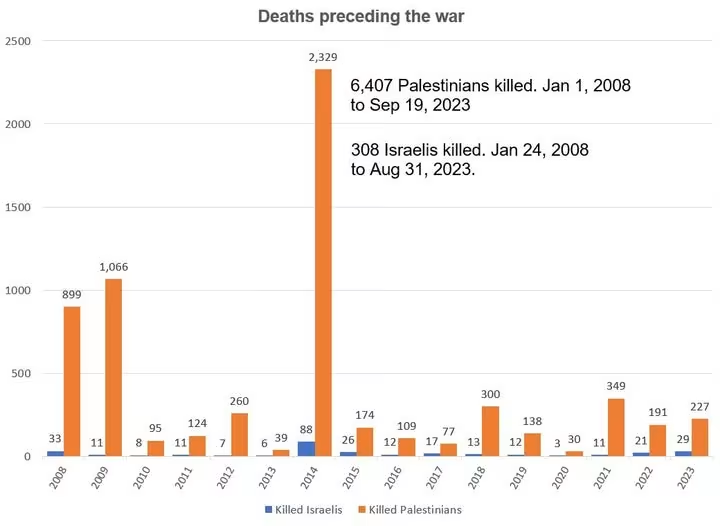
The key to understanding Netanyahu’s narrative about Palestinians is not about any intrinsic violent behavior on their part. That notion is fabricated.
The real key is arithmetic.
Inside Israel’s borders live about 9.9 million people, roughly 7.1 million Jewish and 2.8 million not.
Add to that the 3.2 million Palestinians in the West Bank and the 2.1 million in Gaza, and the total population between the river and the sea comes to about 15.2 million.
Half are Jewish, half Palestinian.
If all were granted equal citizenship, there would be no Jewish majority. Israel would still exist, but not as an ethnically defined state. It would become a democracy of equals, something its current structure cannot accommodate. That is the true existential threat: not violence, not rockets, but equality itself.
To sustain this imbalance, Palestinians must be depicted as inherently violent, irrational, and undeserving of rights. Their resistance, whether armed or peaceful, is reframed as proof of their inhumanity. The more human they appear, the greater the danger to the narrative that justifies their subjugation.
This pattern extends beyond the conflict itself. It is the same pattern Netanyahu has used against Rabin, against the courts, against journalists and protesters. Each opponent must be cast as not merely wrong but evil, not merely misguided but destructive to the nation’s survival. By making every disagreement a matter of life and death, Netanyahu ensures that the public will tolerate any measure of repression in the name of defense.
This is the oldest technique of authoritarian politics: turn power into protection and dissent into betrayal. Israel’s tragedy is that the mechanisms once used to silence a political rival are now used to perpetuate a system of permanent domination. Netanyahu does not fear Palestinian violence.
He fears Palestinian equality, because equality would expose the illusion that his leadership, and the structure that sustains it, are necessary for survival.
The real threat to Netanyahu is not his enemies. It is the possibility that Israelis and Palestinians alike might someday stop believing in the enemies he invents. Once that happens, the logic of siege and self-defense collapses. When the public no longer buys the narrative, the whole apparatus of fear begins to unravel.
That is also the point at which a politics of permanent domination mutates into a politics of mass destruction. When a leader depends on a permanent enemy to justify his own power, the loss of that enemy’s credibility creates a crisis. The simplest way out of that crisis is to escalate, to intensify violence so that the enemy looks irredeemable again. That is why so many genocides are preceded by years of incitement and “security measures.” What begins as demonization becomes mass killing not because of spontaneous rage, but because the political system needs the spectacle of an inhuman foe to survive.
That is why exposing genocide, naming it, documenting it, showing the motive and the plan, is not just moral witness but strategic action.
It denies perpetrators the ability to present mass killing as “necessary,” it alienates allies, it accelerates sanctions, and it drives wedges inside the regime itself.
We can already see the red flags in the mainstream press. The coverage is framed by questions that sound objective but are designed to mislead. We are asked, “Does Israel have the right to defend itself?” while thousands of civilians and children are being killed, as though the scale and method of that killing are secondary details. Or we are asked, “Does Israel have the right to exist?” A question that is both irrelevant and manipulative, because it conflates a state ideology with an entire people and traps the listener in a false binary.
Most viewers cannot distinguish between anti-Zionism and antisemitism, and the media exploits that confusion to silence criticism.
Meanwhile, Palestinians are reduced to a single word: Hamas. Their history, suffering, and humanity are erased. Every dead child is called a militant, every bombed neighborhood a stronghold. It is the same dehumanizing shorthand that always accompanies genocide, the narrative armor that lets an audience watch atrocities and still think of them as defense.
But that narrative is fragile. It requires enormous effort to maintain, with daily repetition, censorship, and the constant invocation of victimhood by the powerful. One wonders how it has held for so long. Yet it cannot endure much longer. Every image, every testimony, every act of witness erodes it.
And this is where Netanyahu’s political survival meets the logic of genocide. His power depends on the same narrative machinery that justifies mass killing. He cannot exist without enemies, and he cannot maintain control without convincing his public that annihilation is defense. The war is not only against Palestinians; it is a war to preserve a political order that would collapse under equality and awareness. As the world begins to see the reality, the fear that sustains him weakens.
The very worst thing for Netanyahu and for the genocide itself is awareness. Genocide cannot survive exposure. It depends on confusion, on silence, and on the false moral balance that turns murder into policy. Those who profit from the continuation of war through oil, arms, or political relevance are not going to stop because they have a change of heart. They are sociopathic actors who treat suffering as opportunity.
But they can be stripped of what they need most: the illusion of justification.
Awareness does this. It pulls away the mask of necessity and reveals cruelty as strategy. It makes it impossible to claim ignorance or neutrality. When enough people see clearly, the machinery of destruction begins to lose its power. That is how genocides end. Not when the perpetrators are persuaded, but when their lies no longer work.
Live, confrontational videos pierce the filters of corporate media and bypass the careful choreography of official narratives. They show what the press is too timid or too compromised to show: the destruction of homes, the killing of families, the faces of the dead. This is why journalists in Gaza have been systematically targeted and killed, and why those who survive risk their lives to continue documenting. It is also why governments have passed anti-BDS laws in open violation of the First Amendment, punishing people not for violence but for the refusal to be complicit. The purpose is to silence the witnesses and criminalize the act of telling the truth. The camera, the protest, and the boycott are treated as weapons because they expose what propaganda tries to hide.
The genocide must stop. It will stop when the world refuses to look away and refuses to believe the story that made it possible. Awareness is how it ends.