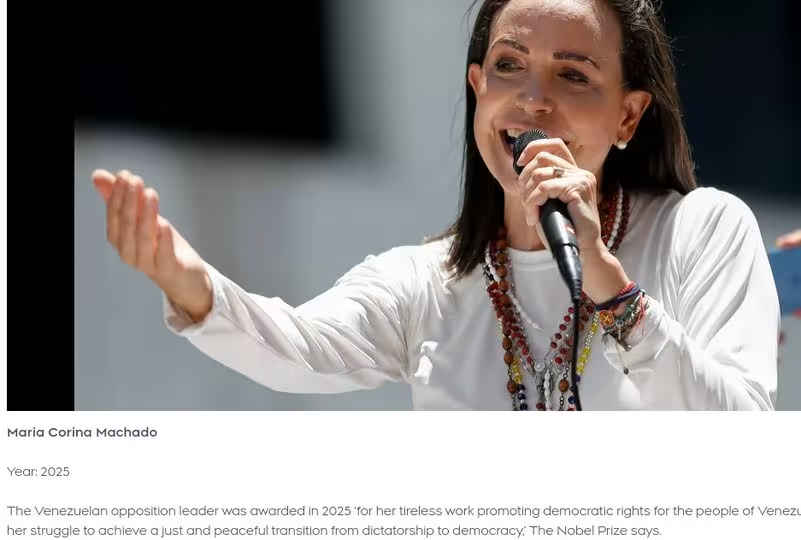
María Corina Machado’s image as a “pro-democracy reformer” is celebrated in Western media but her political orientation and alliances make her a deeply polarizing figure inside Venezuela and across the Global South.
The Nobel Committee’s decision to award her the Nobel peace prize for 2025 fits a pattern: awards given to figures like Liu Xiaobo (China) and Aung San Suu Kyi (Myanmar) served as symbolic rebukes of non-aligned or adversarial governments, while Barack Obama’s prize functioned as an act of political endorsement, projecting faith in Western leadership rather than recognizing tangible peace.
In each case, the prize reflected geopolitics as much as principle, rewarding alignment with Western narratives more than genuine conflict resolution.
For example, under Obama the US expanded drone warfare, proxy interventions, and covert destabilization campaigns that deepened global instability under the banner of humanitarianism.
The West condemns Venezuela not for being authoritarian, but for being disobedient.
It excuses authoritarianism when it serves its interests, and weaponizes democracy when it doesn’t.
While Nicolás Maduro is vilified for holding flawed elections and concentrating power, regimes like Saudi Arabia, Egypt, and the UAE, where political opposition is illegal and dissenters are imprisoned or executed, receive weapons, trade deals, and diplomatic praise.
The difference is not about democracy, it’s about obedience.
Venezuela’s government nationalized oil, expelled foreign corporations, and aligned with independent blocs like ALBA, China, and Russia, actions that threaten Western economic control.
That defiance, not repression, is what triggers outrage.
At the same time, authoritarianism is quietly rising within the United States itself:
mass surveillance, suppression of dissent, militarized policing, media concentration and bias toward corporate narratives, and the control of politics by the wealthy all erode the democratic values Washington claims to export.
The rise of anti-BDS laws, which openly punish political expression in defense of Palestinian rights, marks a blatant violation of the First Amendment, proof that freedom of speech in America is conditional on alignment with state and corporate interests.
Venezuela’s sin is not tyranny, but resistance to empire.
Its suffering is not born of socialism, but of economic warfare, embargoes and sanctions imposed precisely because it chose left-leaning, redistributive policies.
Those same policies, including public housing, free healthcare, universal education, and the socialization of oil wealth, are what once gave Venezuelans one of the highest quality-of-life standards in Latin America.
Until external pressure and blockade strangled their economy.
Thus, “human rights” rhetoric functions as a tool of foreign policy, applied to punish disobedience, not to uphold universal values.
What is condemned in Caracas is tolerated, even rewarded, in Washington and Riyadh.
The empire does not fear dictatorship, it fears independence.