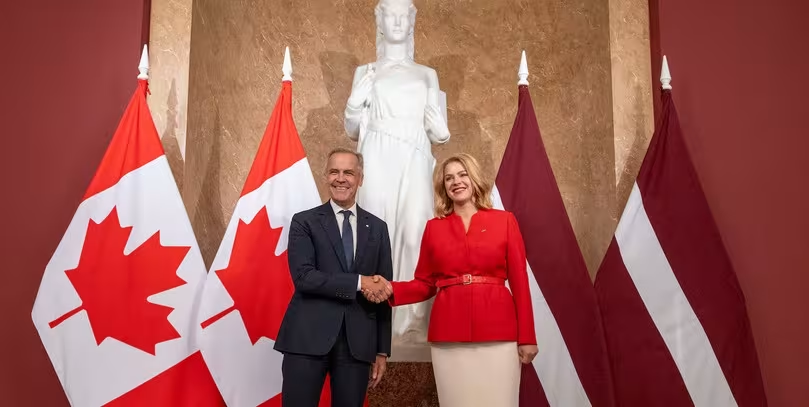
Prime Minister Mark Carney stood in Latvia today, pledging yet another extension of Operation Reassurance, Canada’s largest overseas deployment. He spoke of “deterring and fortifying,” of securing “lasting peace” in Ukraine.
Fine phrases. But let’s pull back the curtain.
This is not about peace. This is about spending. And empire.
The Machinery of Empire
What does the extension mean in practice? Tanks, missiles, and helicopters shipped across the Atlantic. Multibillion-dollar procurement contracts for defence firms. Endless press releases invoking “deterrence” while ignoring the basic truth: NATO’s buildup escalates tensions, it does not defuse them.
Carney tells us this is about security. But for whom?
For Canadian taxpayers, it is a drain: billions funneled into deployments and logistics, money not spent on housing, healthcare, or education.
For Canada’s defence contractors, it is a jackpot: guaranteed markets, steady profits, and state-funded risk-free expansion.
For the United States, it is a bargain: another ally footing the bill, providing legitimacy to U.S. foreign policy, while American arms giants quietly collect subcontracting revenues.
For Latvia’s ruling elite, it is foreign investment disguised as security, enriching landlords and contractors while ordinary Latvians live under the shadow of great-power rivalry.
This is redistribution from the bottom up. Canadian workers pay, elites profit.
The Spending Is the Point
Let us not fool ourselves: it hardly matters whether the money is spent in Latvia, Afghanistan, Libya, or any other corner of the globe. The point is that it is spent. Same shit, different day.
The military-industrial machine requires a permanent outlet for public money to flow into private hands. Wars, interventions, “operations” - these are not just geopolitical choices, they are funding pipelines.
The genius of empire is that it dresses this transfer in noble language. Each new deployment is sold as a defense of democracy, a shield for the vulnerable, a path to “lasting peace.” The substance is always the same: billions redirected upward, while taxpayers are lulled by a feel-good story. The battlefield changes; the grift remains constant.
The Rhetoric of “Peace”
When leaders invoke “lasting peace,” they rarely mean disarmament, diplomacy, or justice. They mean military dominance. They mean peace under NATO’s terms, enforced at gunpoint if necessary.
Canada’s mission in Latvia is marketed as solidarity with Ukraine, but it is also a message to Russia: the West controls Europe’s borders and will not hesitate to expand its reach.
If peace were truly the goal, diplomacy would be the focus. Instead, militarism marches on, contracts are signed, profits soar, and the language of peace becomes the language of war.
Whose Security?
Every dollar shipped abroad is a dollar not spent on the crises Canadians face daily: unaffordable housing, crumbling infrastructure, underfunded healthcare. The ruling class calls this “security,” but whose security is really at stake?
Not the security of workers, tenants, or Indigenous communities. Their needs are sidelined so that Canadian elites can parade on the world stage as reliable managers of empire.
Conclusion
Can you smell the bullshit? Canada’s presence in Latvia is not a humanitarian gesture, nor is it about fortifying peace. It is about maintaining the machinery of spending, ensuring that the flow of public money into private hands never runs dry.
Carney’s extension of Operation Reassurance is not a commitment to peace. It is a commitment to empire. Their empire, not yours, not mine.
Empires ironically cloak themselves in the language of pax (peace). Call today's Pax Pecuniae, the peace of money.
And empire, let us remember, has never been the path to peace.