
Extreme violence is political, not religious.
Across Judaism, Christianity, and Islam, no large-scale, sustained campaign of extreme violence has ever been driven intrinsically by religious goals.
Religion cannot do that.
It does not command armies, raise budgets, build supply chains, or plan invasions. Violence cannot reach the scale of an organized campaign without logistics, hierarchy, resources, territory, soldiers, and political authority.
These are the instruments of rulers and states, not prophets or scripture. Religion can amplify a message, but it cannot produce the machinery of organized war.
Political elites exploit fear, grievance, and insecurity.
They take ordinary cultural or religious differences and reshape them into hardened lines of conflict. What begins as difference becomes division, and what begins as division becomes justification.
Religion becomes the language through which power speaks, not the source of what power seeks.
And the order of causation matters. The political motive comes first. Religious leaders may shape belief among ordinary people, but they do not control the flows of capital or the deployment of armies. Religious beliefs are not strong enough to make someone inflict extreme violence on a population.
But money and power are.
That is how wealth and dominance consolidate themselves. It is self-reinforcing.
Money and power outrank religion and values every time. The ruling class does not subordinate itself to clerics. It recruits clerics to discipline the masses.
Even in a shitshow where a religious figure occupies political power directly, the violence that follows serves the logic of state formation, not spiritual zeal. It's state-building. It is political consolidation dressed in sacred language.
Religion can motivate people, give violence a moral glow, and turn killing into a sacred obligation. But it never replaces the underlying political economy that organizes and directs the violence.
With this in mind, consider what is being concealed when someone insists that “they hate us for our religion, our freedom, our values.” That claim only works when history is erased. It only works when political motives stay hidden.
What disappears from view is occupation, sanctions, coups, extraction, and decades of domination. And when the public reacts with fear or anger toward distant populations, that reaction is not born from doctrine. It is shaped by narratives created by those who own the institutions that manufacture consent.
The root of these conflicts is political struggle, not theological quarrel. The actors who cause wars, and the ones who profit from them, rarely appear in the stories told to the public.
Instead, we are given tales of fanatics and extremists to hide interests that are entirely worldly.
That needs to change.
Whenever you encounter a call to violence claiming to be about religion or values, pause and ask: Who profits from the sale of the weapons. Who commands the bases and why those bases exist. Who controls the flow of trade, the authority over loans, the power to impose sanctions, the right to ship arms, and the media that frames the story.
If the conflict is described as ancient hatred but rests on occupation or geopolitical leverage, it is not religious violence.
It is political violence dressed in religious vocabulary.
It is not Islam, Christianity, or Judaism that created the devastation. It is the Sykes Picot map, the Balfour Declaration, the Truman Doctrine, and the imperial strategies that followed them that have taken millions of lives.
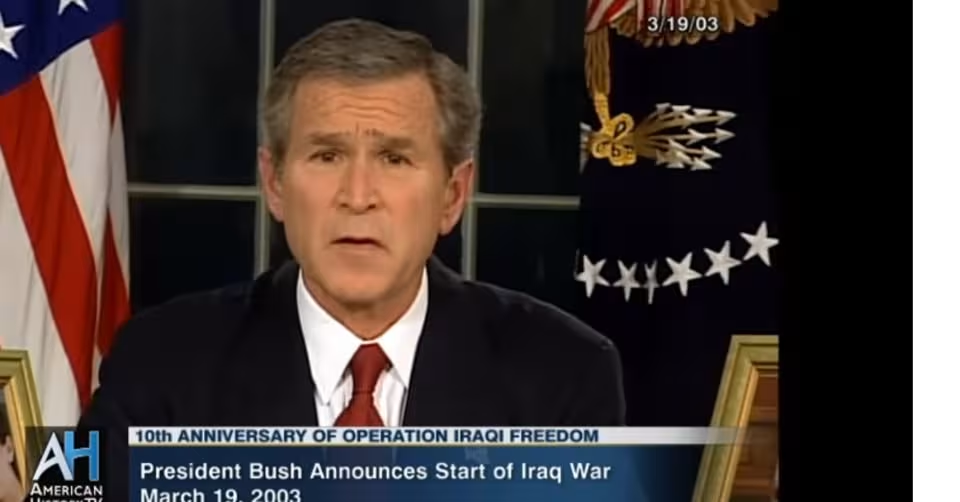
When a reporter asked George W Bush whether he had consulted his father before invading Iraq, he replied, “There is a higher father that I appeal to.” With one sentence, he shifted accountability upward, away from the architects of policy and toward a divine mandate. That response did not express spiritual conviction. It exposed the class structure that underpins political violence.
A president acting as the executive of the ruling class invoked religion to secure obedience from those beneath him. And many accepted it as truth.
And what did this cost ordinary people in the United States:
two to four trillion dollars, thousands of lives, tens of thousands wounded, entire communities living with long-term trauma, and no strategic benefit to the public.
No advancement in peace.
No advancement in the Christian values invoked to justify it.
And what did Iraq receive:
hundreds of thousands dead, likely more than six hundred thousand, mass displacement, shattered infrastructure, sectarian fragmentation, the rise of ISIS, and decades of instability.
Who won:
oil-adjacent corporations, private contractors, the defense industry, intelligence and security agencies, geopolitical strategists, and political elites seeking domestic consolidation. Those are the beneficiaries.
So maybe it is time for a new phrase. Something accurate. Something that points to the real threat.
Call them Radical Capital Extremists.
And I promise you: those individuals are not your defenders.
They are your enemy.