
What we’re seeing today with U.S. killings of Venezuelan nationals is not some isolated security operation. It is part of a long tradition in U.S. foreign policy. Washington identifies a government it doesn’t like, calls it illegitimate, and then proceeds to destabilize it through every available means.
And when economic sabotage and diplomatic pressure don’t move fast enough, the violence begins.
Look at the pattern.
The United States is carrying out assassinations against Venezuelan people in international waters. Not on its own borders, not in a declared war zone, but out in open seas where it claims the right to act as judge, jury, and executioner.
These killings line up neatly with intensified sanctions, with open talk in Washington about removing Maduro, and with a growing military presence around Venezuela. And to justify it all, they drag out the old “narco-terrorism” script, the same pretext they’ve used across Latin America whenever they want to intervene but don’t want to admit the political motive.
They are extrajudicial killings.
And what do these killings accomplish? They do not stop the drug trade. They never have.
The purpose is not to stop narcotics, it is to apply pressure. The strikes create fear and humiliation for the Venezuelan state.
They send a message that the United States will escalate beyond sanctions, beyond diplomatic squeeze tactics, and into direct lethal force.
This is regime-change policy by violent means, plain and simple.
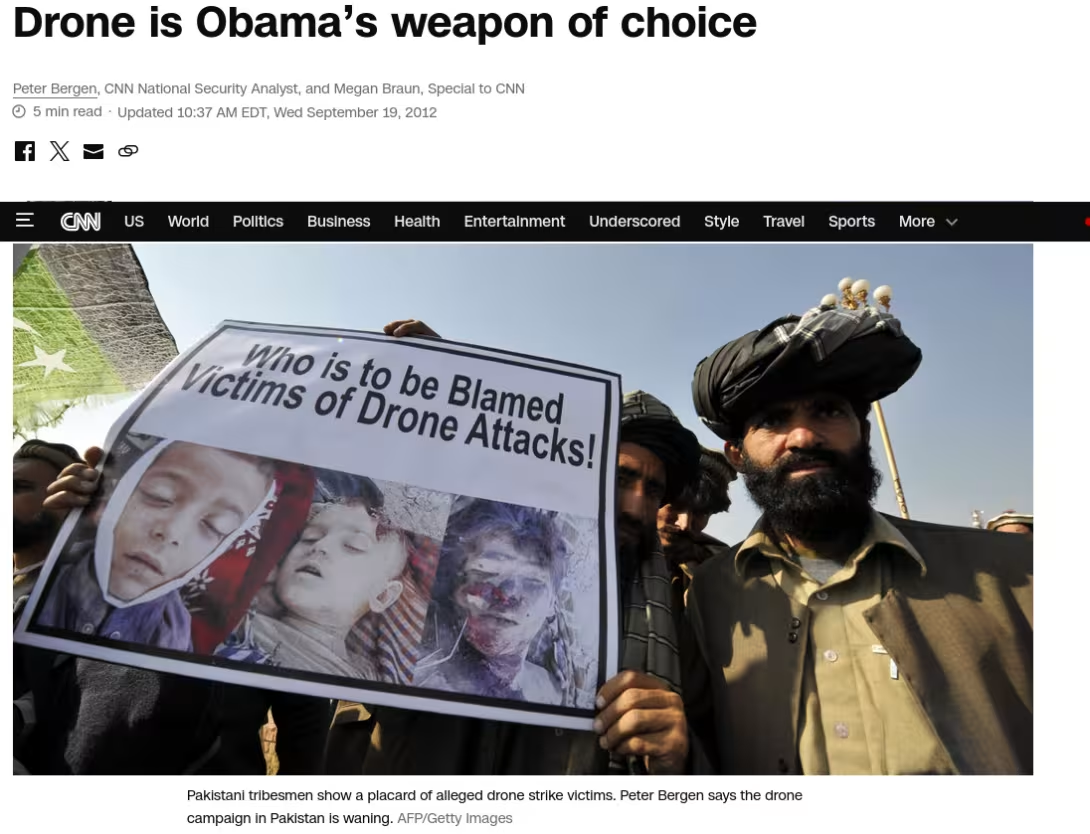
But this is not new. Under Obama, the United States conducted drone strikes in Pakistan, Yemen, and Somalia. The propaganda line was counterterrorism. But the political effects told the real story.
In Pakistan, drone strikes undermined the country’s sovereignty and pressured its leadership to fall in line with U.S. security objectives.
In Yemen, the strikes were coordinated with the Hadi government and helped keep a U.S.-approved leader in power.
In Somalia, they weakened groups hostile to U.S. interests and shaped a state-building process that suited Washington.
These were political interventions dressed up as anti-terror actions. Even when the goal wasn’t to overthrow a government, the violence shifted internal power balances in ways that served U.S. influence.
So, it was political then, and it is political now. The difference is not in the substance, but in the style.
Earlier presidents wrapped these operations in legal jargon and humanitarian rhetoric. Today the story no longer matches the actions, and the contradiction is impossible to ignore.
The objectives are in full view.
And there is a certain clarity in that.
For decades, Washington has been allowed to present its violence as noble, necessary, or reluctant. But now the evidence sits out in the open.
These killings are not about safety or democracy. They are about power. They are about controlling other nations, destabilizing governments that refuse to obey, and enforcing an international hierarchy in which the United States reserves the right to kill abroad whenever it pleases.
These are human rights violations and war crimes of the same kind we are taught to condemn when committed by official enemies. The only difference is that now, for anyone paying attention, the political motives are impossible to deny.