We all get the feeling sometimes that we are living in a simulation.
I felt it the other day reading a BBC article that said 80 percent of Venezuela’s oil profits go “to the government,” clearly implying that this was a bad thing.
What the article did not emphasize is that in Venezuela, those funds are used to pay for hospitals, schools, food programs, and housing.
Now imagine what the United States or Canada would look like if 80 percent of oil profits went to social services!
In reality, roughly 1 percent of oil revenue in the US and Canada reaches the public through taxes or royalties.
The rest goes to private shareholders. Somehow that is treated as normal, even virtuous.
I felt the same disconnect when a serious news piece claimed that “the economy” is the biggest concern for voters. Not rent. Not grocery prices or Loblaw’s record profits. Not whether people can survive on their wages. The economy. As if ordinary people are lying awake at night worrying that corporations are not receiving enough subsidies, hoping that wealth will somehow trickle down if we are patient and work hard enough.
That is when it clicks.
We are living inside a structure. A political simulation that trains us not to see the simulation.
The narratives we inherit about history, identity, morality, and justice are not neutral. They are tools of power.
We’re told that politics is complicated.
And the moment you express disagreement, especially if it challenges power, people don’t usually listen. They lecture. They talk at you. Explaining why your concerns are naïve. Why, no matter what the issue is, the “smart” move is to vote against your own interests.
When a person’s beliefs are based on fear, it’s hard to think critically. You’re wrong because you haven’t learned to think like them. You don’t fear connecting the dots.
So they try to shut it down. Maybe by pointing to some clever historical footnote that’s supposed to discredit your argument. Maybe by accusing you of straying too far from the orthodoxy of one side or another.
They mistake knowing the talking points of the day for insight. And because those narratives are so tightly curated, they treat them as sacred, or at the very least, too “complicated” for you to question.
But politics isn’t complicated at all.
You *do* get a say in what is in your interests. You *do* get to say you don't trust the government and you want accountability. Democracy is based on mistrust.
It really is that simple.
Once you see that, it becomes impossible to unsee it.
We are told that religion causes wars. That terrorism is born in mosques. That colonization was a civilizing mission. That democracy is a gift the West gives to the rest of the world.
None of these are truths. They are cover stories for political interests. They are what power tells us to justify theft, conquest, and domination.
Because that’s good for “the economy” (wealthy people’s yacht money).
Every empire believes it is bringing light to darkness. Every war is framed as defense. Every act of exploitation is sold as progress.
The people subjected to it are dehumanized. They are called primitive, extremist, lazy, corrupt. That makes their suffering easier to ignore and their resistance easier to crush.
When you recognize that your own perceptions were programmed by these political myths, you start asking different questions.
Not “Was this policy good?” but “What structure of power made this outcome inevitable?”
Not “Is this people’s culture flawed?” but “Who profits from portraying them that way?”
At that point, it becomes clear that the problem is not human nature. It is not ancient tribal hatred.
It is the logic of empire.
The logic of extraction.
The logic of hierarchy, dressed up in the language of freedom.
And when you see that, you have a choice.
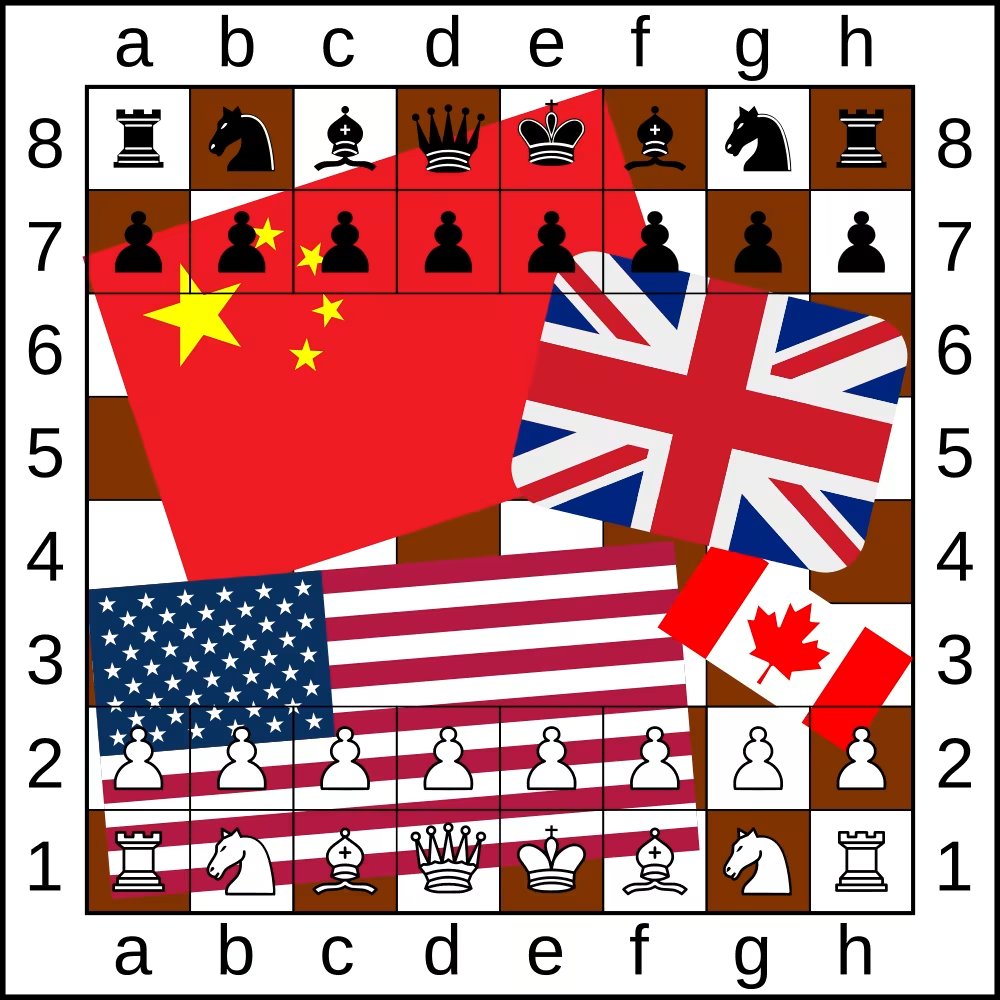
You can remain a piece on the board, moved by rules you did not create. Or you can begin, even in small ways, to disrupt the game.
That disruption starts with clarity. With courage. With refusing to let propaganda shape your moral compass.
Because the moment you start seeing the world as it is, not as it is sold to you, you stop being manageable.
And that is where it becomes a problem.