
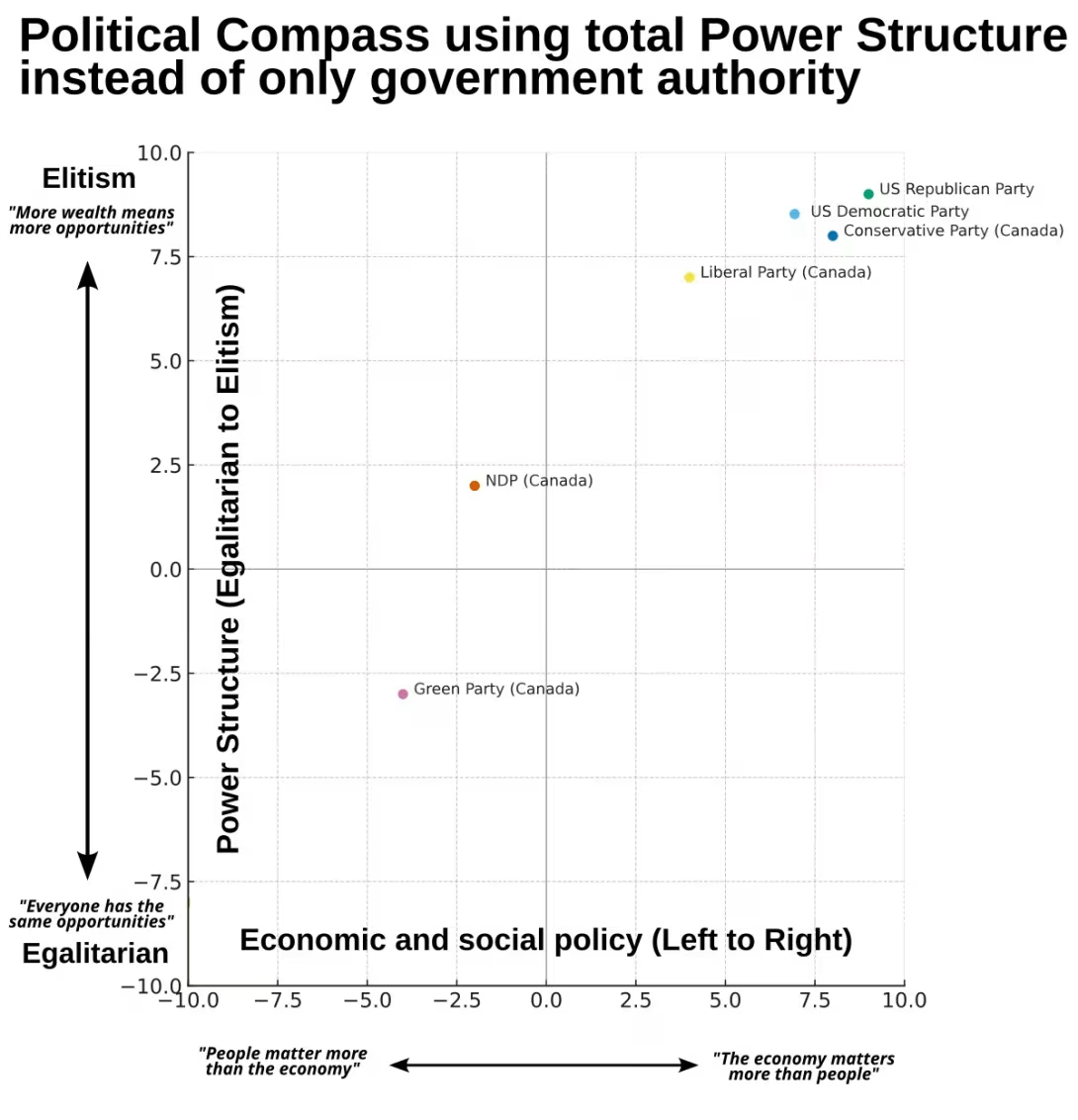
Here is a political compass that uses more meaningful concepts than government authority.
Power in our society doesn’t come from government alone, it comes from an intertwined system of corporations, media, finance, and institutions that shape every aspect of our lives.
Terms like libertarian are vague, inconsistent, and often used to mask these deeper dynamics.
A chart grounded in real-world power structures, and showing where parties and ideologies actually operate is far less misleading than the sanitized models promoted in mainstream political discourse.
Because in those circles, conversations about power are deliberately flattened. The role of concentrated wealth, elite influence, and systemic exclusion is minimized, not because it isn’t real, but because naming it directly would challenge the legitimacy of those who benefit from keeping it invisible.
What does it mean?
On the Left–Right axis, the midpoint reflects a government policy landscape where human wellbeing and economic growth are treated as equally important.
It represents a system where public services, fair markets, and social equity are not in conflict, and government policy aims to support both people and productivity simultaneously.
On the Egalitarian–Elitism axis, the midpoint marks a society partway toward the decentralization of power and wealth.
Privilege still arises from hard work or innovation, but it rarely comes at the cost of others’ access, safety, or dignity.
Some structural exclusion still exists, as it is an inevitable feature of a commerce-based society.
The parties and placement:
US Democratic Party
Center-right (+7)
Elitist (+8)
Corporate donors, think-tank technocrats, elite media class, suppresses grassroots
US Republican Party
Far-right (+9)
Elitist (+9)
Openly plutocratic, oligarchic, white nationalist elements
Liberal Party (Canada)
Center-right (+4)
Elitist (+7)
Polished elite party; reinforces inequality behind diversity optics
Conservative Party (Canada)
Right (+8)
Elitist (+8)
Strong alignment with capital and authority
NDP (Canada)
Center-left (-2)
Moderate-elitist (+2)
Limited internal democracy, defers to parliamentary respectability
Green Party (Canada)
Left (-4)
Moderate-egalitarian (-3)
Decentralist tendencies but fractured and co-optable