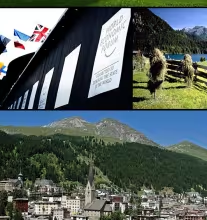
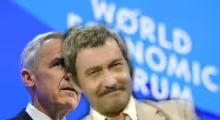
It's nice to see politicians getting up in front of the podium and telling the truth.
Aw!🥹🥹
So basically, Davos is where politicians stop bullshitting.
That’s it.
That’s the whole thing. They get on a private jet, fly to the Alps, and suddenly everyone’s honest. It’s just, “Alright, here’s what we’re actually gonna do, here’s who’s getting screwed, and here’s how we keep the money calm so it doesn’t panic and leave.”
And they don’t lie there because they can’t. Those people can ruin you by lunchtime.
Then they fly home and it's back to vague promises, hope, change, teamwork, whatever word tested well with a focus group of exhausted people who still think voting fixes things.
Because voters don’t have leverage.
We vote once in a while, yell online, then go back to work. We can’t crash a currency because we’re pissed.
The stuff everyone actually agrees on, healthcare, housing, not lighting the planet on fire, suddenly becomes “very complicated” the second it messes with profits.
That’s not confusion. That’s a stall.
Politics isn’t broken. It’s doing its job. It’s just not serving voters anymore.
Its job now is to sell decisions that already got approved somewhere else.
Davos isn’t a betrayal of democracy. That’s the funniest part. It’s the honest version. It’s the map with the arrow saying, “Power is over here.”
Elections are just the part where they ask us which manager we want to explain it to us afterward.
We should have our own Davos.
We should get to see our electeds bend over backwards, fight for what we voted for, and make promises they actually intend to keep like their job depends on it.
Instead, fuck you.
HAHAHHAHAHAHAHAHA!
We don’t get one because if politicians had to stand in front of us and fight for us the way they fight for money, the whole power structure would flip. And it’s not allowed to flip.
It’s wrong. It’s backwards. It should be the other way around. If democracy actually outranked wealth, politicians wouldn’t need to lie at all. They could just say what they’re going to do and then do it.
Michael Parenti was a great scholar and orator. He connected the dots like no one else. He was far more than a collection of sharp quotes.
But here's a great quote from him anyway.
I think it slaps.
"It is the heart of Western policy, ladies and gentlemen, to use fascism to preserve capitalism, while claiming to be saving democracy from communism." -Michael Parenti
Mark Carney's speech at Davos was very well written.
It shows both sides of that quote from Parenti. How someone calls out the problem and then gets a standing ovation for telling us to embrace it is peak.
I guess you score points just for criticizing Trump these days.
Carney gestures toward the truth when he talks about fortresses, coercion, weaponized interdependence, and the collapse of even the pretense of rules. He acknowledges that the old narrative relied on consent and that it no longer holds. But he never follows the logic to its conclusion.
He never says plainly that when consent fails, power does not retreat. It escalates, and violence becomes a governing strategy.
But in the moment, he didn't have to say it - we were all thinking it. These are not abstractions.
We are watching this happen in real time. Attempts to treat Greenland as a negotiable asset. Regime change pursued through abduction and intimidation. Sanctions that quietly kill thousands of people every year by denying food, medicine, and infrastructure. Unwavering political, military, and financial support for the mass killing of Palestinians.
We see it. We know this is violence. We know it is wrong. And yet we tolerate it. We sigh, roll our eyes, call it complicated, and move on. That tolerance is not neutral.
That is "keeping the sign in the window."
This is where the speech becomes illogical, and dishonest. If the problem is that power rests on consent, then the solution cannot be elite coordination and strategic autonomy alone.
The logical response would be to empower the people whose consent has been exploited the most, workers, the dispossessed, those bearing the cost of inequality and injustice. Withdrawal of consent at that level would actually confront the system producing the violence.
Carney proposes the opposite. His solution is to reorganize power among middle states, diversify away from one hegemon, harden alliances, expand military capacity, and stabilize capital.
He presents this as acting in the face of wrongdoing, but it is not action for the greater good. It is action in our own interest. The injustice is not confronted. It is selectively rerouted.
The deception lies there. The speech alludes to moral clarity and truth telling, but the outcome is not justice. It is insulation.
One major perpetrator is cut out, not because domination is wrong, but because it has become unreliable for us. The system that produces coercion, violence, and inequality remains intact, merely redistributed.
Fuck Trump!
But don't change anything.
That is not taking the sign down. It is replacing it with one that feels better to display.
That is exactly the pattern Parenti named. When consent erodes and democratic outcomes threaten economic power, elites do not abandon capitalism.
Values are repeatedly invoked. But none of them are allowed to constrain capital accumulation, military escalation, or coercive leverage.
They abandon democratic constraint while insisting they are defending it. They are not working for you.
When democracy threatens capital, democracy is managed, narrowed, and hollowed out while its language is intensified.
Carney names the WTO, COP and the UN as under threat. The WTO’s central function is to protect the rights of capital across borders, not the rights of people. The COP process acknowledges climate crisis while protecting the economic structures that cause it. Power within the UN is explicitly unequal. Economic strangulation is treated as diplomacy even though it is violence.
Fuck Trump! But fuck the UN, the WTO and COP too! And fuck Carney as well, for reducing my values into opportunity for the wealthy.
So Carney gets up there and says, “We are no longer relying on just the strength of our values, but also on the value of our strength.”
What in the ever loving fuck does that even mean?
That is not a sentence. That is a fortune cookie that went to business school.
That is what you say when you want applause but you absolutely do not want follow up questions.
If you slow it down for half a second, it is not saying, “Hey, we screwed up and now we are going to actually live by our values.” No. It is saying, “We are still gonna throw our weight around, but now we are gonna feel better about it.”
That kind of language always shows up when consent starts to fail and power has to prepare people for more coercion, as force expands to fill the space where legitimacy once lived.
That is it. Same power. Same outcomes. Just better lighting.
Then he goes, “The WTO, the UN, the COP, the whole architecture of collective problem solving is under threat.”
Oh really.
Under threat from whom?
Reality.
These institutions are not some innocent group project that got vandalized. They were built to manage inequality, not fix it.
They exist so rich countries can say, “Hey, this is all very unfortunate,” while continuing to do exactly what benefits them.
If Carney actually represented Canadian values, he would not be saying, “Oh no, we have to save these institutions.” He would be saying, “Maybe we should fix the fact that these things mostly protect capital and screw everyone else.” But that part is not convenient, so we skip it.
And then he brings out Havel. That is when you know something sneaky is happening.
Havel wrote about resisting the communist regime in Czechoslovakia.
Havel talks about the guy who puts a slogan in his window that nobody believes. The whole point is that the system survives because people keep repeating crap they know is false.
Havel is saying, stop playing along. Stop pretending.
Carney hears that and goes, “Exactly. We should stop pretending.” And then immediately adds, “Except for the pretending that keeps everything basically the same.”
He is not saying live in truth. He is saying, “Hey, that old story does not work anymore. Let us get a new one.”
That is not honesty. That is a rebrand.
And notice which slogans he wants to retire. The ones about the rules based order and moral leadership. Fine. Those are not working anymore. Everyone sees through them.
But the one slogan you never hear. Ever. Is the one that actually explains the mess.
"Workers of the world unite."
That one never makes it onto the stage. Funny how that works.
Except as part of Carney's speech - as the slogan everyone was fighting against.
Because that slogan does not prop the system up. It does not prop the wealthy up. It pulls the floor out from under it. It says the problem is not countries competing. The problem is that a handful of people get rich no matter what flag is flying.
That is why it is dangerous. Not because it is outdated. Because it is still accurate.
If Carney wanted to be honest, he picked the wrong philosopher.
Gramsci would have said, yeah, of course consent is falling apart. It was manufactured in the first place. You told people this was normal until they stopped believing you.
Arendt would have said, all this force and coercion you are calling strength. That is actually weakness. That is what happens when legitimacy is gone and you start panicking.
Du Bois would have gone nuclear and said, let us stop pretending this system was ever fair. Democracy and prosperity at the top were always paid for by somebody else.
But you cannot say that at Davos. You would not make it to dessert.
So instead you get Havel Lite. Truth, but not too much truth. Honesty, but only about the stuff that is already collapsing anyway.
The whole speech is basically, “Yes, the mask cracked. So let us glue it back together and act like this time it is different.”
That is not leadership. That is damage control.
And the funniest part is they keep calling this values.
Values are supposed to cost you something. These values pay dividends.
We are lucky the news still tells us what happened.
Who, where, when. But if you stop there, you are missing the game. There is no major outlet that is not owned or shaped by billionaires, and that reality leaks into coverage whether they admit it or not. Luckily the red flags are not hard to see.
Once you see what is missing as much as what is printed, the story changes fast.
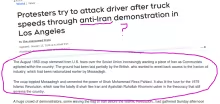
So Associated Press covers a rally for Iranian self determination and calls it an “anti Iran” demonstration.
That was the first thing that caught my eye.
Anti Iran. Like people woke up and said, yeah, screw the country, the food, the culture, the people. That is not what happened. That is like calling someone anti American because they are against the CIA flipping governments. Lazy at best. Dishonest at worst.
AP isn't lazy.
What the protesters were actually saying is simple.
Iran is not broken because Iranians cannot govern themselves. It is broken because outside powers keep putting their thumb on the scale and then acting shocked when the whole thing tips over.
Foreign interference wrecks democracy. It ends badly every time.
Then the article hands you this cute little history snack about 1953. Just a nod. Cold War fears. Communists. Ooo scary.
Meanwhile the real story is that Iran had a democratically chosen prime minister, Mohammad Mossadegh, who nationalized oil so his own country could benefit from it. Britain and the US lost money, panicked, and engineered a coup. They paid people to riot, ran propaganda, destabilized the country, and installed a dictator.
That is not a theory. It is in declassified documents.
But the article smooths that over like an unfortunate misunderstanding. Oops. History happens.
That framing matters, because if you pretend the US just stumbled into Iran by accident, then every future intervention can be sold as stability, humanitarian concern, or protecting civilians. Same pitch, different decade.
Finally, you zoom in on the most chaotic moment of the rally. Yelling. A truck. Confusion. Suddenly the whole protest looks unhinged.
Now the crowd is the problem. Not the history. Not the pattern. Not the fact that we keep lighting fires and blaming the smoke on the locals.
No lies. Just selective facts, bad labels, and a tone that quietly tells you who to side with.
And somehow, once again, it is never the people with the power.
People living inside an imperial center do not wake up one morning to tanks in the streets. They wake up to erosion. To wages that no longer sustain life. To institutions that no longer serve public need. To promises that grow thinner with every repetition. They are told this is temporary. That sacrifice now will bring stability later.
But later never comes.
What people begin to notice is not ideology but contradiction.
They did what they were told. They worked harder. They complied. They adapted. And still the ground beneath them keeps shifting. New day, still fucked.
This moment is unsettling because it forces a question the system works very hard to suppress. What if this is not a failure of the system, but its normal operation?
At first, people struggle to protect their own position. They chase credentials. They attempt to outrun decline. This is understandable. That's precisely the response power depends on.
A population fighting for individual survival is a population that does not organize.
The real shift occurs when the realization moves beyond the individual.
Frantz Fanon understood this well. Writing about colonial societies, he showed how domination survives by persuading people that their suffering is personal, cultural, or deserved. What appears as individual failure is in fact a rational response to imposed conditions. Liberation begins not with outrage alone, but with recognition that what is experienced privately is produced collectively.
Paulo Freire made the same point in the realm of education and consciousness. Oppression, he argued, persists when people internalize it as personal inadequacy. Transformation begins when people see their condition as a common reality shaped by political and economic forces. Without that recognition, outrage becomes noise. With it, solidarity becomes possible.
Hannah Arendt approached the problem from the perspective of power and obedience. Systems of domination rely on isolation. When people experience vulnerability alone, they are easier to manage. Atrocities do not require monsters. They require ordinary people who stop thinking relationally, who no longer ask how their lives are connected to the lives of others.
Separation, not cruelty, is the enabling condition.
James Baldwin spoke to this from inside the imperial center itself. He warned that refusing to recognize oneself in the suffering of others was not innocence, but self deception. A society that defines itself through domination cannot remain psychologically or morally intact. Recognition, Baldwin insisted, was not charity. It was survival.
bell hooks rejected politics rooted in moral superiority or permanent outrage. Domination continues, she argued, when people cling to individual status instead of collective liberation. People do not come together because they are shamed into caring. They come together when they understand that their futures are bound together.
Do you see what I'm getting at?
The most powerful move is not outrage. Outrage can be absorbed. It can be redirected. It can be exhausted.
It's not Trump. It's the system in which Trump works. It's been there since long before he arrived. If you are only outraged at Trump, the same system will continue long after he's gone.
Criticizing Trump is not a power move.
The real power move is recognition.
Recognition that the people who have borne the costs all along are not alien, defective, or lesser, but subject to the same human constraints with fewer protections.
This is where politics changes.
Fighting for the individual self reinforces competition. Fighting for the collective self undermines it. One response fragments. The other creates cohesion grounded in shared exposure to the same system of power.
It's not ideology. It's seeing reality.
And today, this recognition is becoming harder to contain.
The scale of current events has grown too extreme to be safely managed as background tragedy. Violence is no longer distant. Suffering is no longer abstract. It unfolds continuously, in plain view. This creates a problem for the establishment, because suffering at this scale threatens legitimacy.
It takes only a single moment of empathy for the logic to break. One moment when someone recognizes that the people of Palestine, Venezuela, Sudan, Yemen, the former Yugoslavia, and countless others are not suffering because of ancient hatreds or inevitable chaos, but because their suffering serves profit.
Not the public good. Not universal security. Profit.
Their dispossession stabilizes markets. Their poverty maintains leverage. Their deaths are treated as unfortunate but necessary costs in a system organized around return on investment rather than human need.
Once this connection is seen, even briefly, the moral narrative collapses.
This is why language becomes evasive. Why suffering is framed as tragic but unavoidable. Why entire populations are reduced to abstractions or threats. This is why dehumanization is manufactured. The objective is not simply to justify violence, but to prevent identification. To keep the line between them and us intact.
Because the moment that line breaks, the system is revealed for what it is. Not a moral order. A transfer mechanism.
And this is when unraveling begins.
Not because people suddenly become virtuous, but because they recognize that the machinery grinding others down is now grinding toward them. That there is no permanent inside. No protected class immune from the consequences of endless accumulation.
At that point, outrage is no longer the danger to the system.
Recognition is.
Because recognition turns spectators into participants. It transforms isolated anxiety into shared understanding. It makes collective action a matter of necessity, not altruism.
That is the real power move in dark times.
Not outrage. Not purity.
Recognition.
Understanding that dehumanization is fake - it's a tool designed to keep you afraid and compliant.
Seeing that the people who have been paying the price all along are not alien, defective, or lesser, but operating under the same human constraints with fewer buffers.
That is how movements stop being symbolic and start becoming dangerous to entrenched power.
Not because they are loud, but because they are hard to divide.
Once people see it clearly, the story cannot be restored.
A couple notice their neighbors outside arguing in the driveway. One raises their voice, the other turns around and walks back into the house. It lasts maybe thirty seconds. That’s all it takes.
Thirty seconds and boom, we’ve got a verdict.
One person in the observing couple reacts instantly. Case closed. Walks away? That tells them everything they need to know. Bad person. Cold. Cruel. Must be a nightmare to live with. One tiny clip from the movie and they’re already writing the review. Five stars for certainty, zero stars for curiosity.
The other person looks at the same thing and goes, hold on. We saw almost nothing. We don’t know what that argument was about. We don’t know what happened five minutes earlier or five years earlier. Maybe walking away was the smartest thing that happened in that driveway all day. Maybe staying would’ve turned it into something worse. They’re not excusing it. They’re just refusing to pretend they’ve seen the whole truth because they caught a glimpse through the bushes.
That’s the difference right there.
It’s not about being nicer or more moral. It’s about how fast you slap meaning onto things. One way crushes a complicated situation into a neat little label and feels very proud of itself. The other keeps the picture open and admits that most of what drives human behavior never shows up in a quick public moment anyway.
Now take that same habit of thinking and zoom it way out.
A lot of people in the United States are starting to wake up to the long, ugly pattern of US imperialism and the way the West invents reality and manufactures consent for war. What’s changing isn’t access to information. We’ve had information for decades. What’s changing is how people are learning to look at it.
This whole system works because the news is designed to hit you fast and hard. Here’s the bad guy. Here’s the crisis. Here’s the threat. Feel something right now. Be scared. Be angry. Be morally certain. Then move along. No time to ask questions. No time to think. Reaction first, understanding never.
Almost every major news story does this. Sometimes they’re subtle, sometimes they’re clumsy, but the goal is the same. Strip away context. Chop off history. Make everything look isolated and accidental. Never let you ask who benefits. Never let you notice what else is happening at the same time. Definitely don’t let you connect the dots. That’s dangerous.
But when people stop reacting on command and slow the hell down, the magic trick stops working. Patterns start to show up. You notice whose suffering is treated like background noise. You notice how certain kinds of violence are framed as tragic but necessary, while others are framed as unforgivable evil. Funny how that works.
What’s happening isn’t about learning new facts. It’s about refusing to let each story pretend it’s the whole story. It’s about keeping the frame open long enough to see power moving around, instead of swallowing the version of reality that just happens to flatter the people already running the show.
And if you want a few basic tools for cutting through the fog, here they are.
- First, it’s about power. Not oil. Not money. Power. Oil and money only matter because they give someone leverage. Take Venezuela. Everyone talks like the fight is over who gets to own the oil. That’s cute. Ownership is optional. Control is the prize. If you can box it in, choke it off, delay it, sanction it, you don’t need to pump a single barrel yourself. You just keep prices high and alternatives scarce.
And here’s the beautiful part. They can step back and say, “You know what? We’re gonna leave it in the ground. It doesn’t belong to us.” See? Look at that. Moral. Responsible. Good people. Meanwhile, leaving it right where it is happens to be the move that benefits them the most. Prices stay high, leverage stays intact, and nobody has to look like the villain. That’s power. Quiet. Indirect. Smiling for the camera. Meanwhile nobody cares that Venezuelans will continue to suffer, business as usual. Their only crime is having oil.
- Second, dehumanization is always a red flag. Anytime a news story keeps nudging you to see a group of people as dangerous, irrational, or less than human, your alarm bells should be screaming. Fear is incredibly useful. Once people stop seeing others as fully human, empathy goes right out the window and suddenly atrocities turn into policy decisions. That framing isn’t accidental. It’s doing a job.
So here’s a little mental trick. The next time you catch yourself believing in the boogeyman, stop. Reverse the thought. Say to yourself, “This could be anybody under the same conditions.” Sit with that for a second. Wait for it. “Holy shit. This could be *me* under the same conditions.”
What if all I ever knew was poverty and violence because I grew up in a place that was devastated by war.
Someone else's war. I'm hated by people who don't even know me, but they were given a story about people like me.
Have you ever heard that kind of story on the news?
- Third, ridicule is information. When you start questioning a narrative and the response isn’t an argument but mockery, dismissal, or bullying, congratulations. You hit a nerve. Power doesn’t panic when you’re wrong. It panics when you’re close. When the conversation shifts from debate to sneering, that’s usually your cue to keep digging, not to shut up.
That shit-eating grin might make you angry at first. Good. Don’t float above it. Don’t calm down. Don’t retreat into politeness. Hit them with facts. In French, there’s a phrase for that kind of face, une face à taper dedans, a slappable face. So slap it. Not with fists, with context. With empathy. With evidence. Slap it until the smugness cracks and something real has to come out.
Because part of that grin is cognitive dissonance. It's discomfort. It's hard to pivot to a new set of facts. It's extra hard because not only do you feel ignorant for not having seen it before, but coming to terms with the realities of imperialism means you're not the good guy anymore.
We're not.
That discomfort is healthy. We should all learn to be able to sit with some discomfort.
Because when we take it away, when we people-please, when we avoid being disagreeable, we place comfort above truth. And we already know how catastrophic avoiding the truth can be.
We cannot have justice for Venezuela in this economy.
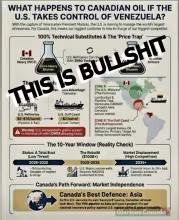
Twenty five years ago, Canadian oil was not some unstoppable juggernaut. It was expensive, dirty, politically awkward, and barely worth the trouble unless oil prices stayed high. The oil sands were a gamble. Everyone knew it. Nobody was chest-thumping about Canada being an energy superpower back then.
Meanwhile, Venezuela is sitting on massive heavy oil reserves that are basically the same stuff Canada pulls out of the ground. Same refineries. Same use. The difference is not the oil. The difference is where the money went. Venezuelan oil revenue was being used to build schools, hospitals, and social programs instead of getting funneled straight into the pockets of Western oil executives and shareholders. And right there, that’s the real problem.
So suddenly, there’s a crisis. Not because anyone thought Venezuela was uniquely corrupt or incompetent. Not because the oil stopped working. The story just shows up one day, fully assembled. Corrupt. Failed state. Dictator. Say it enough times and people stop asking questions.
Then come the sanctions. Then the financial chokehold. Then production collapses. Millions of people suffer. Tragic. But that suffering was not an unfortunate surprise.
It's bad luck Venezuela.
And wouldn’t you know it, right as Venezuelan oil gets shoved off the market, Canadian oil suddenly makes sense. High cost projects become profitable. Infrastructure gets built. Shareholders start smiling again. Funny how that works. Totally a coincidence, I’m sure.
BTW, it’s called “Canadian oil,” but the people who own it are the same people who own “American oil.” Same investors. Same corporations. Same balance sheets. Regular people in either country are not cashing in.
If we actually benefited from those profits, we would already have been Venezuela’d.
We get about one percent through taxes and fees if we’re lucky. The rest goes straight up the food chain.
Here’s the part people really don’t want to say out loud. The goal was never to take Venezuelan oil and pump more of it. That would drop prices. That would hurt profits. The goal is to keep it in the ground. Sanctions, destabilization, asset seizures, invasions, whatever tool fits the moment. Less oil on the market means higher prices. Higher prices mean Canadian oil stays viable and more importantly, the same group of people keep getting rich.
And there’s an extra layer of shit baked into this. A brown skinned country using its own resources to take care of its own people instead of obeying the shareholder rulebook. That’s dangerous. That sets a bad example. You let that work and suddenly other countries start getting ideas.
Can’t have that.
The Canadian oil sector depends on this story continuing. Venezuelans must remain poor. They must continue to suffer. So Venezuela has to stay “corrupt.” That narrative is not a side effect. It is the permission slip that keeps their oil suppressed and everyone else’s infrastructure profitable.
That is why there is such aggressive pushback the moment you challenge the dictator narrative. The response is not to engage with facts or history, but to shut down critical thinking.
Suddenly everything is a “nuanced debate.” Doesn't that seem pretty unusual to you? Suddenly the focus shifts to Trump’s misstep, his tone, his recklessness, anything that keeps attention safely away from the long record of policy, incentives, and outcomes that predate him by decades.
This should be a moment where the media pauses and asks hard questions. Instead, it is treated as a threat. An opportunity to puncture a thin layer of propaganda is turned into an exercise in reinforcing it. Critical thinking is framed as irresponsible. They scold. They close ranks. Context is treated as suspect. The narrative is not examined, it is protected.
Here’s the ugly truth. The prosperity of the Canadian oil sector is structurally tied to the suffering of Venezuelan people. That’s not a glitch. That’s the system doing exactly what it was designed to do.
That is empire.
And honestly, the one accidental service Trump’s fuckup did was make it harder to pretend it wasn’t happening. He said the quiet part loud.
Once you see it, you can't unsee it.
Nothing will change for Venezuela. They will go on suffering - Mark Carney's popularity is high and he will make sure the narrative that sanctioning Venezuela is the thing to do. We're the good guys. Meanwhile, Cha Ching!
If Americans truly want to confront authoritarianism, they have to stop treating it as a personality problem or a Trump problem.
I hear that many Americans are outraged about what's happening in Venezuela, but it's not really about Venezuela.
It is about Americans saying their president is behaving like an authoritarian - making declarations of war without congressional approval. But they are beginning to notice the exercise of power that has always been there, just usually hidden behind smoother language and better manners.
People say they are shocked by what their government has done. They say he crossed a line, he violated procedure. And they are right to be disturbed. But here is the problem. They are reacting to the style, not the substance. They are reacting to the clumsiness, not the crime.
You see, outrage is permitted when it’s symbolic, but discouraged when it threatens power. Insult Trump all you want, we don't care, but we will not encourage you to actually talk about Venezuela.
Nobody today should actually believe Nicolás Maduro is a dictator because there is extensive, on the record evidence that the United States has actively destabilized Venezuela for more than two decades, and that this destabilization was intentional. Calling Maduro a dictator is hypocrisy.
This is not speculation, not conspiracy, it's public record. And the press knows it, and still repeats the story.
The tools used have been political, economic, diplomatic, and informational rather than military, but their cumulative effect has been to narrow Venezuela’s sovereignty and make normal governance extremely difficult regardless of who holds office. Sanctions are usually an act of violence.
First, the US has directly intervened in Venezuela’s political process. After the failed 2002 coup against Hugo Chávez, US agencies including National Endowment for Democracy and USAID dramatically expanded funding to opposition parties, media outlets, and political infrastructure. Chavez took back the oil expropriation contracts from the oligarchs.
These programs were not neutral civic education efforts. They supported electoral strategy, messaging, parallel vote counts, and international lobbying designed to delegitimize elected governments. Imagine Russia doing this in Canada or Mexico.
In 2019, the US went further by recognizing Juan Guaidó as president despite his never being elected to that role, seizing Venezuelan state assets abroad, and urging allies to reject Venezuela’s existing institutions outright.
That act alone shattered any claim of respect for Venezuelan self determination. So much for international law, so much for democracy.
Second, the US has used economic sanctions as a political weapon, with predictable social consequences. Sanctions escalated sharply after 2017 and targeted Venezuela’s oil sector, financial system, and access to global credit. These measures collapsed state revenue, restricted imports of food and medicine, accelerated inflation, and drove mass emigration.
Starve them, then blame them.
Multiple UN officials and economists have noted that these outcomes were foreseeable and not accidental.
When elections are held under conditions of engineered scarcity and economic crisis, the resulting dysfunction is then blamed on leadership rather than on the coercive environment that produced it and the media repeats it as though it’s an objective diagnosis.
Third, the US has conducted sustained narrative warfare around Venezuelan legitimacy. Elections are routinely declared illegitimate in advance, regardless of turnout, observation, or results, while opposition boycotts encouraged by foreign governments are later cited as proof that elections lacked credibility.
Media framing consistently isolates Nicolás Maduro from the context of sanctions, asset freezes, and diplomatic isolation, creating the illusion that Venezuela’s collapse is uniquely domestic. This framing would not be accepted if applied to countries aligned with US interests under similar pressures.
So, calling Maduro a dictator is hypocrisy.
When the US rejects elections it dislikes, recognizes unelected leaders, and punishes entire populations to force political outcomes, it forfeits the moral authority to declare another government illegitimate.
What is presented as a defense of democracy is, in practice, a long running campaign to control political outcomes while denying responsibility for the damage that campaign causes. Democracy is invoked as a slogan while policy serves investors, oil companies, and geopolitical dominance.
It's an invented reality and you are not supposed to see it.
But Trump is a clumsy motherfucker. Trump makes the quiet part loud.
The United States did not suddenly lose its democratic compass under Donald Trump. The systematic destabilization of Venezuela began long before him.
This started under Barack Obama. Venezuela, a poor country, was formally declared an extraordinary threat, a legal fiction that opened the door to sanctions.
Again, these are all facts that are on record and verifiable. So it's an insult to anyone's intelligence to pretend otherwise. It's outrageous.
Under both Obama and Joe Biden, financial isolation intensified, assets were frozen, oil revenues were strangled, and political legitimacy was deliberately undermined. Under Trump, the same policies continued, with added theatrics and less diplomatic camouflage. Different presidents, same machinery. Same interests.
What Trump changed just the other day was not policy but visibility.
His bluntness tore away the humanitarian language, the talk of norms and values, that usually disguises coercion. Suddenly Americans could see what had long been done quietly. The outrage they feel now is real, but it is misdirected if it stops with Trump.
The authoritarianism they are alarmed by did not begin with him. It has been operating politely, administratively, and with bipartisan approval for decades, especially beyond US borders. And it comes home eventually.
It already has. You've been lied to. You see it.
And here is the final insult. For years, Americans were fed a simplified story about Venezuela. Dictator. Socialist failure. Hopeless corruption. Almost every outlet, every expert panel, every talking head repeated it while omitting the role of sanctions, asset seizures, and overt interference. Propaganda by omission.
That was not an accident. It was narrative discipline. To be shown only part of the story while being asked to consent to the consequences is an insult to people’s intelligence and to their freedom.
If Americans truly want to confront authoritarianism, they have to stop treating it as a personality problem or a Trump problem. It is a structural feature of empire. Trump did not invent it. He just made it harder to pretend it was not there. The empire is the problem.
You want to fight for your freedom? You've got to think critically, connect the dots, follow the money, follow the power, and you've got to aim way higher than Trump.