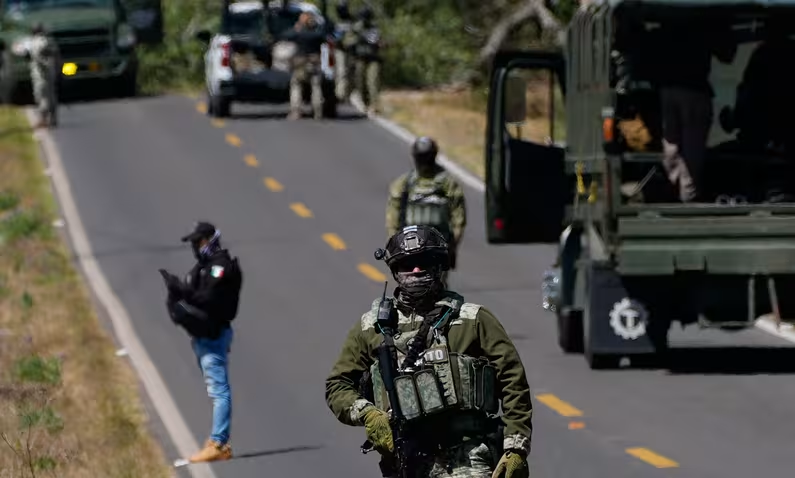
The recent cartel spectacle in Mexico with burning trucks, masked gunmen, highways transformed into war zones, looked like the apocalypse. But it wasn’t. There were no mass civilian killings, no indiscriminate terror. Just targeted disruption, designed to shock but not destroy.
The cartels could have slaughtered thousands. Instead, they torched OXXO stores (symbols of corporate Mexico), blocked gas stations, and paralyzed roads, not to terrorize, but to demonstrate power.
To create a disturbance that big and to not lose control is not just luck. That doesn't just happen.
Less than five civilians died, mostly from accidents or smoke inhalation. Just enough to dominate headlines, not enough to provoke all-out war.
What we saw in Mexico was a calculated demonstration of power and not a random event.
It’s strategic. And like most other demonstrations of power, a few people die. For example: Economic sanctions (where people starve or are denied life-saving medicine), coups (where chaos and confusion cause people to shoot one another), or resource grabs (where resistance is crushed just enough to keep things moving) all follow the same logic.
Those in power don't care about killing a few people. But extreme violence is a last resort. The goal isn’t annihilation, it’s control.
Now that we’ve established this is not random, questions follow: So why now? Why kill El Mencho, head of the Jalisco Cartel, when Mexico has known where he was for years?
I don’t know for sure. But fear is political currency. Every government needs a boogeyman, a terrifying enemy to justify crackdowns, distract from failures, and keep the U.S. at bay. The cartels need the boogeyman too to remind everyone who’s really in charge.
In the end,
El Mencho will be replaced.
The government will declare victory.
The U.S. will keep demanding action.
And the cycle will repeat because real change would mean dismantling the system that keeps everyone in power. And no one wants that.
The show goes on. Violence isn’t the problem, violence is the point.
But now we see it.
When we recognize that cartel violence, or economic sanctions, or coups, or resource grabs, are all calculated demonstrations of power and not justice, not chaos, not revolution, we stop being controlled by fear.
The burning trucks in Mexico, the starving civilians under sanctions, the chaos after a coup, aren’t accidents. They’re tools of control, designed to force compliance, justify crackdowns, or distract from the real game.
The spell breaks.
We understand that fear is the currency, and confusion is the weapon. And once we do, we can resist the manipulation.
We can demand real solutions instead of performative crackdowns. We can call out the hypocrisy of sanctions that starve civilians while regimes stay in power.
We can reject the idea that violence is inevitable, or that some people’s suffering is just the cost of someone else’s control.
That’s how they make us believe dehumanization is natural.
The system depends on our fear. But we can connect the dots and take back that power.
-
-
Plus also: If you look upon these types of headlines and worry about *tourism*, that's some colonialist bullshit right there. Maybe reflect on that a bit. There are actual people living there.