
It is clear that negotiations between the United States, Israel, and Iran were not conducted in good faith.
Iran was attacked twice in less than a year while negotiations were underway. Third-party observers, along with the United States’ own intelligence assessments, indicated that Iran was prepared to negotiate seriously and make concessions that were already on the table.
Yet while the language of diplomacy was being spoken, the machinery of war was already in motion.
We can speculate about why the United States and Israel chose to attack, but speculation is less important than consequence. The consequences are already visible. The evidence suggests that this was a profoundly bad strategic decision, one whose repercussions will reshape the future of energy and shipping throughout West Asia.
Early in the conflict, U.S. radar systems and military installations in the region were struck and rendered unusable. For decades we were told that the American military presence across the Gulf Cooperation Council states was the guarantor of order and stability. That is the mythology of empire.
When those systems fail, the mythology cracks. What now appears is something different: a military network that is be more of a liability than an advantage. And so the balance of power shifts.
At the same time, reports that the United States has been redirecting military resources from other theaters into the Gulf raise serious questions for its allies elsewhere. Countries that rely on American security guarantees are watching closely. They see equipment moved, interceptors redirected, priorities reshuffled.
They see what every smaller nation eventually discovers: the American security umbrella is not a permanent shield. It appears and disappears according to Washington’s interests.
Combine that with the perception that Iran was attacked while negotiations were still underway, and the damage to American credibility becomes severe. Diplomacy requires a minimal level of trust, even among adversaries. If negotiations can be abandoned midstream while bombs are already being prepared, then why should any adversary trust the next round of promises?
That leads to the central question: how do you end hostilities with an opponent that you believe will not honor agreements?
From Iran’s perspective, the answer is simple. You do not rely on promises. You rely on leverage.
Geography provides one of the most powerful forms of leverage available. Iran sits astride the Strait of Hormuz, one of the most critical oil shipping routes in the world. A substantial portion of global energy flows through that narrow corridor. If Iran can influence access to that passage, it possesses a powerful instrument for shaping the behavior of other states.
Under that logic, oil shipments may continue to move while access is selectively influenced by political alignment. Countries perceived as opposing U.S. military expansion in the region might encounter fewer obstacles. Others may discover that the risks of passage have increased.
For the United States and Israel, the options for altering this dynamic are limited.
One option is escalation.
The other is narrative management.
And narrative management is already underway.
We see it in the headlines. Media coverage routinely frames Iranian actions as isolated aggression rather than part of a wider war involving multiple actors.
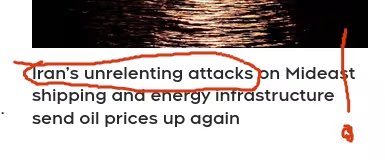
Consider a headline such as:
“Iran’s unrelenting attacks on Mideast shipping and energy infrastructure send oil prices up again.”
Now compare that with a more accurate description of events:
“War in the Gulf disrupts shipping and energy infrastructure, pushing oil prices higher.”
The difference is not merely stylistic. It is ideological. One assigns blame to a single actor. The other acknowledges that a broader conflict is shaping the global energy system.
This is how public perception is managed. You simplify the story, isolate the villain, erase the context, and repeat the narrative until it becomes common sense.
When fear-based narratives dominate the media environment, reality becomes distorted. And once reality is distorted, populations can be persuaded to consent to policies that they would otherwise reject.
We have seen this pattern repeatedly. Major U.S. military interventions have been justified in the language of humanitarian concern or regime change. Yet the historical record tells a very different story.
Libya remains fractured after the 2011 intervention. Iraq endured years of devastation following the invasion of 2003, and millions of civilians were killed. Somalia and Syria continue to struggle with the consequences of prolonged instability and foreign involvement.
You cannot invade, sanction, or embargo a country into a more fair and democratic government.
It's not rocket science.
But invading, sanctioning, or embargoing a country reinforces power and wealth. That's why it's done.
Power is adaptive. As people begin to recognize these patterns, those who hold political and economic power refine the techniques used to shape public opinion. The contradictions remain in plain sight but somehow, nothing changes.
Even when public support for war falls below twenty percent, military operations can still proceed if the institutional checks on power have been weakened enough. The rhetoric of democracy may remain, but the mechanisms that once constrained the exercise of power quietly erode.
And so these things continue to happen.
They happen because societies allow them to happen.
Recognizing propaganda is not radical. Questioning official narratives is not extreme. Thinking critically about war and the use of violence should be a normal expectation in a democratic society.
But when critics raise these questions, they are often dismissed as extreme or irresponsible. Opposing civilian deaths is labeled unrealistic. Questioning military escalation is called naive.
And that reaction reveals something important.
It reveals discomfort.
And sometimes discomfort is the first sign that the conversation is beginning to break through the boundaries that power prefers to keep firmly in place.
Power wants you to complain about Trump and hope for the best at the midterms. And do nothing else. Say nothing else. Pipe down. Don't wreck it for the democrats.
They are full of shit.
Pipe up. Use your brain. You are being sold a bunch of contradictions and the only thing that makes sense is that power is looking after itself. Nothing will change if you keep looking the other way.